

A property can do two things at once.
It can appreciate, and it can open a door: to a residence permit, a tax position, a second base for a family. The first of those is what most people think about when they buy. The second is governed by a set of rules that move quietly, rarely make headlines until they have already changed, and almost never appear in the brochure for the building.
This post is about those rules: what residency by investment actually is, why real estate keeps ending up at the centre of it, and why the smart way to approach it is backwards from how most people start.
Start with the door, not the building
The instinct, when you have decided you might want to live somewhere else part of the year, is to start looking at houses. Scroll the listings. Fall a little in love. Then find out, much later and often too late, that the apartment you liked does not qualify for anything (wrong value, wrong region, wrong type of title).
The more useful order is the reverse. You start with what you are actually trying to achieve, whether it is a residence permit, a friendlier tax position, or an exit option for your family. Then, you let that goal eliminate countries before you ever look at a single property. Only the markets that still offer the route you want survive to the next round. Then you check the fine print of each surviving program, and only then do you go looking for the building.
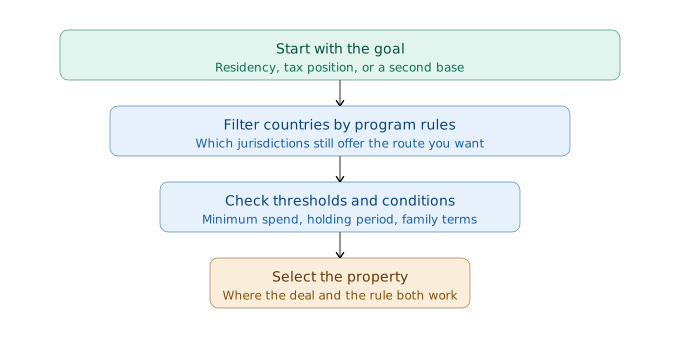
The diagram above shows that funnel. Each stage throws out options, so that by the time you are looking at properties, every one of them already satisfies the rule you care about. It is slower at the start and far faster at the end.
This is the difference between buying a home and buying a home that happens to qualify.
Why real estate, specifically
Governments could grant residency for all sorts of investments, and many do, where sometimes it is enough just to invest an X amount into the local bonds.
But real estate has stayed the most popular vehicle for a simple reason: it is legible. A property has a value everyone can see, it sits physically inside the country, and it cannot be quietly moved offshore the week after the permit is issued. For a state trying to attract long-term capital without handing out passports for cash, a property requirement is easy to write into law and easy to verify.
For the buyer, the appeal is that the asset does two jobs. If the residency rules change, you still own a building that produces rent and may appreciate. The permit is the upside; the property is the floor.
That dual nature is exactly why these decisions deserve real research rather than a sales conversation. The agent showing you the apartment is paid when you buy the apartment. Whether the apartment also gets you the visa you came for is, to them, a secondary detail.
The same money buys very different doors
The clearest way to see how much the rules vary is to look at markets that are otherwise comparable in size and stability and notice how differently they treat the property-to-residency question. The three cards below lay out the contrast.
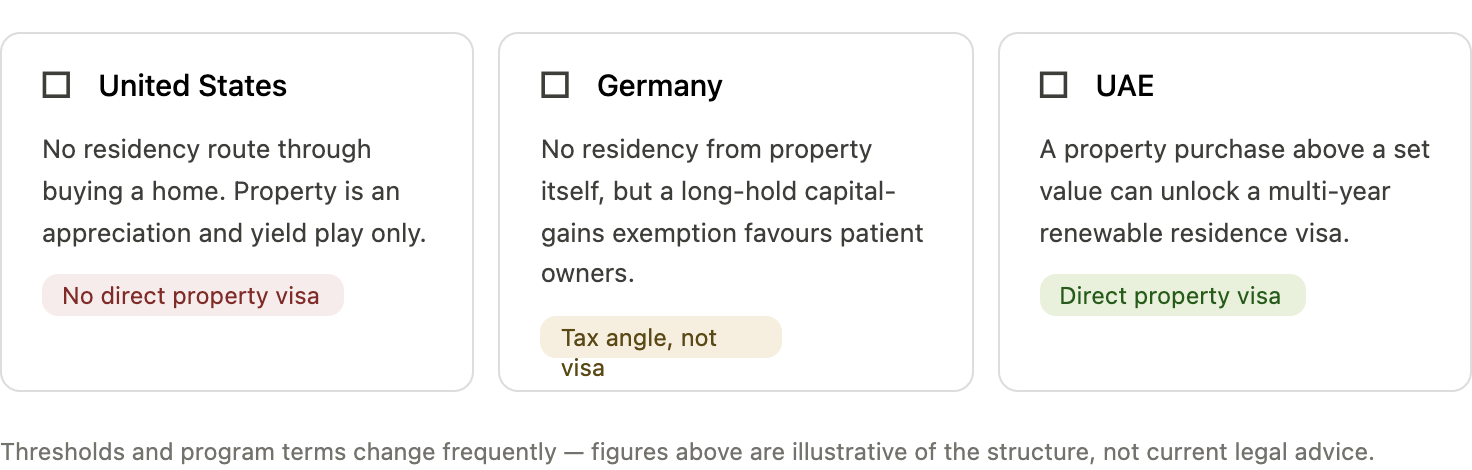
In one market, buying a home gets you nothing on the residency front. The property acts purely as an appreciation and yield decision, and the only way to live there long-term runs through entirely separate, hard-to-access channels.
In another, there is again no residency route through property, but the tax code quietly rewards patient owners: hold long enough and the gain on a sale can be treated very differently than a quick flip.
And in a third, a purchase above a defined value can directly unlock a renewable, multi-year residence visa for you and your family.
Same asset class. Same broad profile of buyer. Three completely different answers to "what does this property get me beyond the property." None of that shows up in the price per square metre.
INSIGHT: The mistake is treating "good market" and "good market for my goal" as the same question. A booming property market that offers nothing you actually want is a worse choice than a flat one that does.
The rules move
Programs get suspended. Thresholds get raised, usually after a market has already heated up. Whole routes get closed to certain nationalities, or restricted to certain regions, or replaced with something that looks similar but works differently. These changes are often announced with little fanfare and take effect faster than a property transaction completes. By the time a change is widely discussed, the window it describes has frequently already shut.
This is the real argument for top-down research over a property-first search. The question "is this a good apartment" has an answer that stays roughly true for years. The question "does buying this apartment still get me residency" can have a different answer this quarter than it did last quarter. The second question is the one that actually constrains the decision, and it is the one most likely to be out of date in your head.
What good research actually looks like
For a decision this size, "good research" is not a feeling of confidence.
It is a small number of boring, specific, current facts, gathered in the right order:
The economic case (yields, price trends, the cost of holding) tells you whether the property is a sound investment on its own terms, independent of any permit.
The legal and tax layer (thresholds, holding periods, who in your family is covered, how a sale is taxed years later) tells you whether the property does the second job you are buying it for. And the date on that second layer matters as much as the content, because it is the part most likely to have changed.
Get those in the wrong order and you fall in love with a building before you know what it can do for you. Get them in the right order and the building is the last decision you make.
The point
Real estate as a path to residency and a better tax position is not a loophole or a trick. It is a legitimate, well-trodden route that a growing number of ordinary investors are taking deliberately. What trips people up is rarely the buying. It is starting from the property instead of the goal, and trusting a picture of the rules that has quietly gone stale.
Decide what door you are trying to open. Let that eliminate the countries that cannot open it. Check the fine print, and check its date. Then, and only then, go look at the building.
The VantageRE research team writes on cross-border property, tax, and residency. Independent, no sponsored coverage, no sales scripts.
Join the VantageRE private beta — country pages, comparison tools, and live datasets.